Farm Animal Papers: 16 Coordinated Designs
Whether you’re designing a birthday invitation for a barn-themed party, crafting educational flashcards for preschoolers, or developing packaging for an organic farm-to-table brand, Farm Animal Papers AMB-1493 delivers cohesive, high-quality visual resources—ready to use, easy to adapt, and thoughtfully built for real creative work.
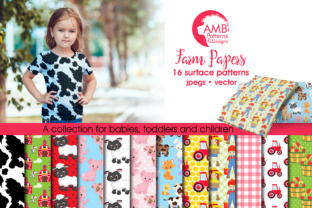
These aren’t generic clipart bundles or low-res downloads. Each of the 16 papers is a full 12" × 12" JPEG at 300 dpi, created with original, hand-crafted clipart and intentional color and pattern coordination. Reds echo classic barns, soft greens nod to pastures, and warm neutrals ground playful animal motifs—pigs, cows, chickens, sheep, tractors, hay bales, stripes, chevrons, and more—all designed to sit comfortably together in one layout or across multiple touchpoints.
Why Coordination Matters More Than You Think
In design, consistency builds trust. When your invitation, thank-you card, and event signage all pull from the same palette and pattern language, your audience subconsciously registers professionalism—even if they don’t know why. Farm Animal Papers makes that cohesion effortless: no mixing mismatched fonts or scrambling to match a cow print with a tractor border. Every paper shares underlying rhythm—scale, contrast, spacing, and tone—so you spend less time editing and more time creating.
This matters whether you're a small business owner launching a line of farm-inspired baby blankets or a teacher preparing hands-on literacy centers. With coordinated papers, your printed materials feel intentional—not assembled.
Practical Uses Across Real Creative Roles
For educators and homeschoolers: Print individual papers as themed backgrounds for vocabulary cards, sight-word mats, or seasonal bulletin board displays. Use the red barn pattern behind “B is for Barn” posters; layer the pig print under a cut-and-paste life-cycle activity. Because all 16 papers share resolution and scale, resizing for laminated flashcards or digital slides stays crisp.
For small business owners and makers: Apply Farm Animal Papers directly to product packaging—think gift tags for honey jars, backing sheets for seed packet inserts, or liner paper inside custom favor boxes. The chevron and stripe options add subtle texture without overwhelming hand-drawn labels or minimalist branding. Pair the cow print with neutral kraft paper for contrast, or use the tractor motif on a shipping label background to reinforce brand personality.
For scrapbookers and memory keepers: These papers go beyond standard layouts. Try using the striped paper as a photo mat beneath a candid shot of kids feeding goats—or overlay a translucent white shape (like a cloud or speech bubble) on the barn paper to spotlight a handwritten journal entry. Since each design is saved separately, you can build layered digital pages in Photoshop or Canva without losing quality.
For marketers and content creators: Repurpose patterns into social media templates—add text overlays to the pig paper for Instagram story announcements, or use the red barn background as a consistent header across a blog series on sustainable farming. The high-resolution files scale cleanly for both web and print, so your Pinterest pins and postcards stay sharp.
Getting Started Without Overcomplicating It
You don’t need advanced software to begin. Open any JPEG in Canva, Google Slides, or even Microsoft Word. Drag it in as a background image, then add text boxes, photos, or shapes on top. For physical projects, import into your printer’s layout tool and adjust margins to avoid cutting off key details—especially important with border-heavy designs like the chevron or barn silhouette papers.
Keep your output clean and audience-focused by limiting text density. On invitations, let the paper’s charm do the work: use large, legible fonts in white or black (depending on background contrast), and reserve decorative type for single words only—“Welcome,” “Join Us,” or “Farm Fest.” For educational uses, ensure animals are clearly identifiable at thumbnail size; Farm Animal Papers’ original clipart avoids overly stylized abstractions, making recognition reliable across age groups.
Styling Tips That Make a Difference
- Pair intentionally: Combine a bold pattern (like the red barn or pig cluster) with a quieter one (such as subtle stripes or gingham) rather than stacking two high-contrast prints.
- Respect white space: Even with playful themes, clutter dilutes impact. Leave breathing room around photos and headlines—especially when printing double-sided or assembling multi-page booklets.
- Test before finalizing: Print one sheet at home first. Colors shift between screens and paper; what looks vibrant on your monitor may mute on matte cardstock. Adjust brightness or contrast slightly if needed—most editing tools allow quick tweaks without degrading quality.
- Stay brand-aligned: If your project has an existing voice—whimsical, rustic, modern-farm, or educational—choose papers that support it. The tractor print reads more energetic and industrial; the soft cow spots feel gentle and nurturing. Let tone guide selection.
More Than Just Paper—A Flexible Creative Foundation
Farm Animal Papers isn’t just about aesthetics—it’s about reducing friction in the creative process. Knowing you have 16 harmonized, production-ready assets means less time sourcing, matching, and troubleshooting. That saved time adds up: an extra hour to refine messaging, test audience response, or iterate on a prototype.
It also invites experimentation. Try reversing a paper’s colors digitally (inverting light/dark values), using only part of a pattern as a watermark, or converting one design to grayscale for a monochrome series. Because all files are high-resolution and individually named (e.g., “FarmAnimal_CowSpots.jpg”), organizing and retrieving what you need stays simple—even across large projects or team collaborations.
And while the theme is unmistakably pastoral, its versatility extends beyond literal farm contexts. A child’s science unit on animal habitats? Use the papers to differentiate biomes visually. A community garden’s volunteer newsletter? Apply the tractor or hay bale print to highlight upcoming workdays. A boutique coffee roaster naming a blend “Pasture Blend”? The barn paper becomes instant shelf appeal.
What ties these uses together isn’t nostalgia or trend—it’s utility grounded in thoughtful design. Farm Animal Papers gives you structure so your ideas can move forward, not stall at the first formatting hurdle.