Earth Tribal Backgrounds: A Practical Guide for Designers and Crafters
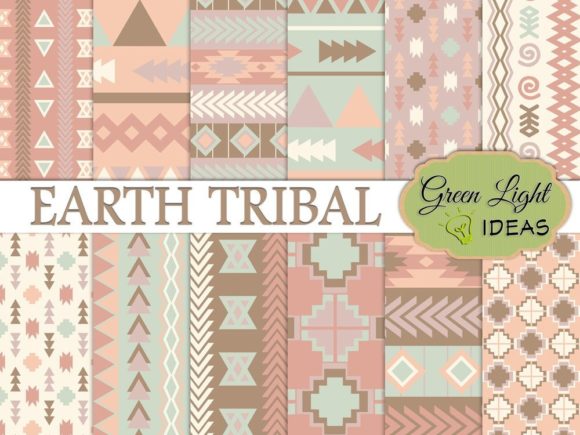
Earth Tribal Backgrounds is a curated digital paper pack that brings together tribal motifs, ethnic textile influences, and Native American-inspired patterns—all rendered in grounded, natural earth tones. It’s not just another collection of repeatable textures; it’s a cohesive set designed with intentionality around color harmony, cultural resonance, and versatile application. The pack includes 12 high-resolution digital papers—each 12” x 12” (3600 px × 3600 px) at 300 DPI, saved in JPG format—making them suitable for both print and digital workflows without quality loss.
What Sets Earth Tribal Backgrounds Apart
Unlike generic tribal pattern bundles that prioritize visual density over cohesion, Earth Tribal Backgrounds emphasizes tonal consistency. Its palette centers on warm terracottas, deep forest greens, charcoal grays, ochres, and muted siennas—colors drawn from soil, stone, clay, and dried plant life. This grounding gives the designs a sense of authenticity and quiet confidence, rather than trend-driven flash. Each pattern balances repetition and variation: some feature subtle geometric repeats reminiscent of Southwestern weaving, others echo hand-stamped motifs or carved wood grain, while a few incorporate organic line work evoking natural flow or ancestral symbolism.
The distinction isn’t just aesthetic—it’s functional. Because all 12 papers share the same color family and resolution standard, they layer well within a single project. You can mix a bold zigzag background with a softer dot-and-line overlay without clashing, something that’s harder to achieve when assembling disparate tribal assets from multiple sources.
How It Fits Within Broader Design Options
When evaluating design resources, crafters and designers often consider three broad categories: thematic collections, modular pattern libraries, and single-purpose templates. Earth Tribal Backgrounds sits firmly in the first group—but with characteristics that blur those lines.
Compared to modular libraries—like those offering hundreds of isolated motifs for custom arrangement—Earth Tribal Backgrounds provides ready-to-use, balanced compositions. That saves time for users who want strong visual impact without needing illustration or layout expertise. However, it offers less flexibility for users who require fine-grained control over scale, spacing, or motif placement.
Against single-purpose templates—such as pre-designed invitation suites or planner page kits—Earth Tribal Backgrounds trades convenience for adaptability. You won’t find built-in text placeholders or layered PSD files here, but you gain full freedom to resize, recolor (within limits), crop, or combine these papers across media: printed scrapbook pages, heat-transfer vinyl for fabric, sublimation-ready mug backgrounds, or even laser-etched wood blanks.
Real-World Use Cases and Practical Tradeoffs
In scrapbooking, Earth Tribal Backgrounds works especially well for heritage-themed layouts—family history projects, travel journals from Southwest U.S. or Central America trips, or nature-focused memory books. The earthy tones complement aged photo prints and kraft paper elements without competing for attention. For card making, pairing a subtle tribal paper with clean typography creates contrast that feels intentional, not cluttered.
Planner dividers benefit from the pack’s balance of visual interest and legibility. Unlike highly saturated or busy patterns that make handwritten notes hard to read, these backgrounds provide texture while leaving ample negative space for headers or checkboxes. One user reported printing them onto sticker paper for removable monthly tabs—a use case not advertised but entirely viable due to the consistent 300 DPI resolution.
That said, limitations exist. Because the patterns are JPG-based and not vector or layered files, editing options are constrained. You can’t easily isolate individual motifs for repositioning or recoloring in software like Illustrator or Procreate without manual masking. If your workflow depends heavily on editable layers or SVG exports, this pack won’t meet that need. Likewise, if your project requires strict cultural accuracy—say, for educational materials about specific Indigenous nations—you’ll need to supplement these designs with expert consultation and attribution, as Earth Tribal Backgrounds draws inspiration broadly rather than representing any one tradition authoritatively.
When Earth Tribal Backgrounds Is the Right Choice
This pack shines when your goal is cohesive visual language across multiple handmade or small-batch items. Think: a wedding suite where invitations, menu cards, and thank-you notes all share a unified earth-and-tribal sensibility—or a boutique stationery line launching seasonal collections rooted in natural themes.
It also suits makers who value efficiency without sacrificing aesthetic integrity. If you’ve spent hours searching for “Southwest pattern,” “earth tone seamless background,” or “Native American inspired paper” only to download mismatched files with inconsistent sizing or washed-out colors, Earth Tribal Backgrounds eliminates that friction. All 12 papers arrive in the same dimensions, resolution, and color space—no resizing, no color correction, no guesswork.
Another fit is for hybrid creators: those who move between physical and digital outputs. Because the files are high-resolution JPGs—not web-optimized PNGs or low-DPI previews—they hold up equally well on a printed fabric swatch and a digital mood board. That cross-platform reliability matters more than ever for artists selling on Etsy, teaching online workshops, or building branded content for social media.
When You Might Need Something Else
If your work involves frequent color customization—say, matching brand guidelines down to a specific Pantone—then a vector-based tribal pattern pack would give you more precision. Similarly, if you’re designing for commercial licensing or large-scale production (e.g., wallpaper, apparel lines), you may need extended commercial licenses or scalable formats beyond JPG, which this pack doesn’t include by default.
For educators or cultural practitioners developing curriculum or community resources, Earth Tribal Backgrounds should be treated as artistic reference—not representation. It doesn’t replace collaboration with knowledge keepers, nor does it substitute for context-rich learning tools. In those cases, pairing this pack with authoritative texts, museum archives, or Indigenous-led design resources strengthens both ethics and impact.
Making an Informed Decision
Choosing design assets isn’t just about what looks good—it’s about alignment with your process, goals, and values. Earth Tribal Backgrounds supports makers who prioritize harmony over variety, practicality over complexity, and warmth over stark minimalism. It’s ideal for those who want to express connection—to land, ancestry, craft traditions—without resorting to cliché or appropriation.
Ask yourself: Do I need plug-and-play consistency across multiple projects? Am I working primarily in print or hybrid media? Is my audience responsive to tactile, grounded aesthetics rather than sleek or futuristic ones? If yes, Earth Tribal Backgrounds likely fits. If instead you’re iterating rapidly across dozens of color schemes, building interactive digital products, or working under tight cultural sensitivity requirements, other resources may serve you better—even if they demand more setup time.
Ultimately, Earth Tribal Backgrounds is a tool—not a solution. Its strength lies in how thoughtfully it narrows scope to deliver something focused, usable, and quietly expressive. That focus makes it easier to say no to distractions and yes to work that feels true.