9 Vegetables Motif: Handmade Patterns for Creative Work
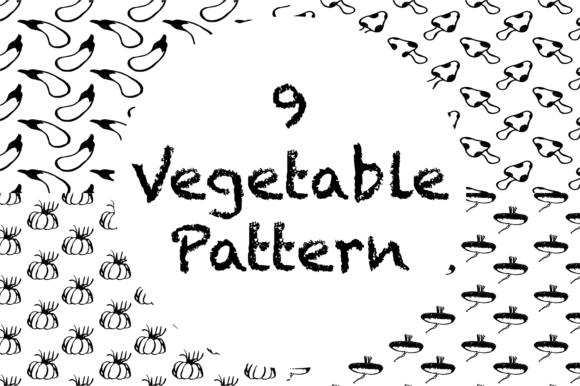
Imagine opening a design project and instantly having nine distinct, hand-drawn vegetable motifs—carrot, tomato, bell pepper, broccoli, eggplant, zucchini, corn, pea pod, and onion—each crafted with warmth and character. That’s what the 9 Vegetables Motif collection offers: a set of thoughtful, artisanal pattern elements designed not just to look charming, but to work well across real-world creative tasks.
What Makes These Motifs Stand Out?
These aren’t generic clipart or AI-generated placeholders. Each motif was drawn by hand, then carefully digitized into clean vector format. The result is organic flow and subtle imperfections—like gentle line variation or soft edges—that give designs personality without sacrificing scalability or precision.
The collection includes two key deliverables: one AI file containing all base elements (the individual vegetable outlines and details used to build each pattern), plus nine separate AI files, each holding a ready-to-use 400×400 mm seamless pattern tile. That means you can drop them straight into textile mockups, packaging layouts, or web backgrounds—or deconstruct and remix them freely.
Why Designers, Educators, and Small Business Owners Reach for This Set
People choose the 9 Vegetables Motif when they need visual warmth paired with flexibility. A food blogger might use the tomato or corn pattern as a background for a seasonal recipe card. A kindergarten teacher could print the broccoli motif on labels for classroom bins. A ceramicist might trace the eggplant outline onto a mug design before carving.
It bridges simplicity and sophistication. Beginners appreciate how easy it is to start—no complex layering or color theory required—while professionals value the high-resolution vectors and intentional spacing that make scaling and editing intuitive.
Real-World Uses You Might Not Expect
- Product packaging: Apply the zucchini motif as a repeating border on eco-friendly snack boxes.
- Educational printables: Use the carrot and pea pod motifs in flashcards teaching plant parts or healthy eating.
- Stitch guides: Import the patterns into embroidery software—the clean lines translate beautifully to cross-stitch or appliqué templates.
- Workshop handouts: A nutrition coach adds the bell pepper motif to a handout about vitamin C sources—making facts feel friendlier.
- Local market branding: A small farm stand uses the corn and tomato motifs across tote bags, chalkboard signs, and social posts for consistent, grounded visuals.
How It Fits Into Your Workflow—Without Disruption
You don’t need advanced Adobe Illustrator skills to benefit from this set. If you’re comfortable placing an image or adjusting colors, you’re already halfway there. The AI files open directly in Illustrator (CS6 and newer), and each pattern tile is built at true 400×400 mm size—ideal for printing on fabric, wallpaper, or large-format vinyl without resampling.
Because the base elements are included in one master AI file, you can easily recolor individual vegetables, adjust stroke weight, or isolate parts for custom illustrations. Want just the leafy top of the carrot? Unlock the layer and copy it. Need the pea pod in mint green instead of sage? Change the fill in seconds.
Things to Keep in Mind Before You Download
First, these are vector patterns—not raster images—so they’ll stay sharp whether printed on a postcard or a 6-foot banner. But that also means they’re best used in vector-friendly apps (Illustrator, Affinity Designer, InDesign) or exported to PNG/SVG for broader compatibility.
Second, while the motifs are stylized, they’re rooted in botanical accuracy—so they feel authentic, not cartoonish. That makes them especially useful for audiences who value sincerity over flash: wellness brands, gardening co-ops, school gardens, or sustainable product lines.
Third, the handmade origin matters. These motifs weren’t generated from prompts or traced from photos—they were drawn with intention, then refined. That shows up in balanced proportions, expressive curves, and thoughtful negative space—details that help your final piece feel considered, not assembled.
Who Benefits Most—and Why
A freelance graphic designer building a client’s farm-to-table restaurant identity finds the 9 Vegetables Motif saves hours on custom illustration. An educator preparing a unit on plant life cycles prints the motifs on durable cardstock for sorting activities. A maker launching a line of organic baby food jars uses the corn and pea pod patterns as subtle texture behind clean typography.
Even if you’re just starting out, this set gives you access to professional-grade assets without needing to hire an illustrator—or spend weeks learning vector tools. It lowers the barrier to creating cohesive, thematic visuals while keeping your voice intact.
A Few Practical Tips for First-Time Users
- Start with one motif—like the tomato tile—to test how it looks at different scales before committing to full-page coverage.
- Try layering a light vegetable pattern beneath bold text—it adds depth without competing for attention.
- Use the base AI file to create variations: flip the eggplant horizontally, duplicate the broccoli three times in a row, or group the carrot and pea pod for a “harvest duo” badge.
- Remember that white space is part of the design—these motifs breathe best when given room to settle, not cram.
Ultimately, the 9 Vegetables Motif isn’t about filling space. It’s about bringing grounded, joyful visual language into projects where authenticity matters—from a child’s lunchbox note to a boutique grocery’s seasonal campaign. It’s handmade, versatile, and quietly thoughtful—exactly the kind of resource that grows more useful the longer you keep it in your toolkit.